
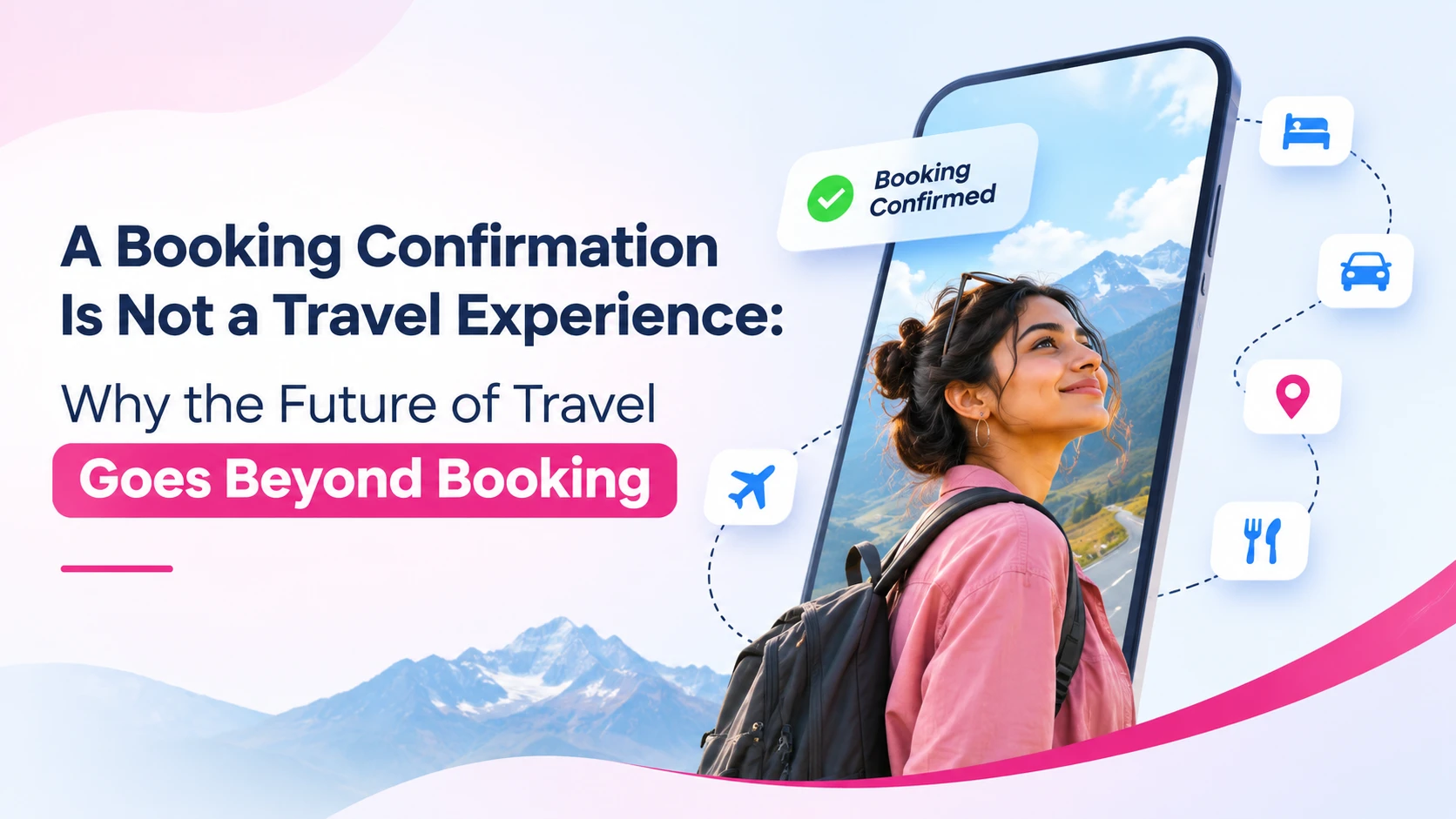
Booking a flight, reserving a hotel, or confirming a holiday package has never been easier. With the growth of online travel booking, travellers can compare prices, explore destinations, select accommodation, and receive instant booking confirmations with just a few taps. Whether using travel booking sites or choosing a travel booking app, the digital travel industry has made planning and purchasing more convenient than ever.
But there is a fundamental problem: a booking confirmation does not mean the travel experience is sorted.
In reality, booking is only one small part of a much larger journey. Once the payment is completed, travellers still have questions about airport transfers, check-in procedures, weather conditions, local transportation, nearby attractions, and navigating an unfamiliar destination.
The journey continues, but the support often becomes fragmented.
This creates a gap between what travellers book and what they actually experience. The future of travel will not be defined simply by how quickly people can complete travel booking online. It will depend on how seamlessly their entire journey is connected.
1. The False Finish Line: Payment Confirmation
For years, the travel industry has focused heavily on simplifying transactions. Online travel agencies and booking platforms have invested in making flight searches faster, hotel comparisons easier, and payments more secure.
These developments have solved an important problem: access to travel bookings.
However, they have also created a misleading perception that completing a booking means completing the planning process.
Consider a traveller booking a flight from Delhi to Bengaluru. The payment is successful, the ticket arrives in the inbox, and the confirmation screen displays a successful transaction.
But several questions remain:
When should the traveller leave for the airport?
What are the baggage allowance and check-in requirements?
How will they reach their hotel after landing?
What transportation options are available?
Where can they find reliable local recommendations?
The booking platform has completed its transaction, but the traveller's journey has barely begun.
The industry has become efficient at selling travel, but the experience surrounding that purchase remains disconnected.
2. The Overlooked Questions Before the Flight
The period between booking a ticket and reaching the airport is filled with small but important decisions.
Travellers need to monitor departure schedules, understand airport requirements, check weather conditions, organise documents, and plan their transportation.
Although these tasks appear simple individually, managing them across multiple platforms creates unnecessary friction.
For example, a traveller might use one application for flight updates, another for weather forecasts, a maps application for directions, and messaging platforms to coordinate with family or travel companions.
Even after completing their online travel booking, travellers must independently organise these different aspects of their journey.
The information exists, but it is scattered.
The bigger issue is not the absence of travel information. It is the absence of contextual information that connects different stages of the journey.
A flight reminder becomes more useful when it is connected to the traveller's departure location, airport arrival requirements, and transportation plans.
Similarly, a weather update becomes more valuable when it helps travellers make decisions about packing, sightseeing, or local activities.
Travel technology must move beyond simply providing information. It must make that information relevant to the moment in which a traveller needs it.
3. The Airport-to-Arrival Handoff: Where the Real Experience Begins
One of the most overlooked stages of travelling is the transition from the airport to the destination.
A traveller may have successfully completed their flight, but arriving in a new city introduces an entirely different set of challenges.
They need to understand the airport layout, identify transportation options, locate their hotel, communicate with local service providers, and make decisions in an unfamiliar environment.
For someone visiting Bengaluru, Mumbai, or Jaipur for the first time, even a simple task such as finding the right airport exit or choosing reliable transportation can become stressful.
This is where the travel experience often breaks down.
The booking platform knows the traveller's flight details. The hotel knows the reservation. The navigation application knows the location. But these services rarely work together as one continuous experience.
The traveller is left connecting the dots.
A more connected travel ecosystem would make this transition smoother by linking booking information with arrival requirements, navigation, local recommendations, and relevant assistance.
Instead of treating arrival as a separate activity, technology should recognise it as the next natural stage of the same journey.
4. Why Travellers Still Need Multiple Apps to Complete One Journey
The modern traveller has access to more digital tools than ever before. Yet having more applications does not necessarily create a better experience.
A typical journey might involve:
Booking platforms: For flights, hotels, and other reservations.
Navigation applications: For directions and location discovery.
Weather applications: For forecasts and travel conditions.
Review platforms: For restaurants, attractions, and local experiences.
Communication applications: For coordinating with travel companions and service providers.
Local discovery platforms: For finding experiences and recommendations.
Travel booking sites and applications have made purchasing travel services convenient, but they do not necessarily connect everything that happens after a reservation.
Each application serves a specific purpose. The problem is that travellers must continuously switch between them, search for relevant information, and manually connect different pieces of context.
This creates what can be described as the fragmentation of the travel experience.
The opportunity is not necessarily to replace every existing application. It is to create an intelligent experience layer that connects relevant information and helps travellers understand what to do next.
Travel should feel like one continuous journey, not a collection of unrelated digital interactions.
5. The Future: A Companion Layer That Connects What Happens Next
The next evolution of travel technology will focus on continuity, context, and trust.
Imagine a travel companion that understands your booking details, knows your destination, and helps you navigate the different stages of your journey.
Before departure, it can help you stay informed about your flight, weather, and travel preparations.
During transit, it can provide relevant updates and help you make timely decisions.
After arrival, it can connect you with navigation, local experiences, and reliable recommendations that make exploring an unfamiliar city easier.
This is where iZhinga aims to make a difference.
Designed around the idea of a connected travel experience, we goes beyond traditional travel planning to bring together the different stages of a journey. From pre-departure preparations and travel updates to navigating unfamiliar destinations and discovering trusted local experiences, the focus is on making every stage feel more seamless and supported.
Rather than focusing only on helping travellers find travel booking sites or complete travel booking online, we focused on what happens after the booking is confirmed.
With its travel companion approach and Local Guru ecosystem, we aim to reduce the friction between booking a trip and actually experiencing it through trusted local insights and contextual travel support.
Because knowing where to go is important, but knowing what to trust matters just as much.
Conclusion
The travel industry has made remarkable progress in simplifying bookings. But the next big opportunity lies beyond the transaction.
Travellers don't measure their journeys by how quickly they receive a confirmation email. They remember how easily they reached the airport, how confidently they explored a new city, how smoothly they handled unexpected situations, and how connected the entire experience felt.
By connecting different stages of travel, iZhinga aims to make the experience more seamless, informed, and trustworthy. It shifts the focus from simply completing a reservation to supporting travellers throughout their journey.
Because travel should not feel like switching between multiple disconnected services. It should feel like one continuous journey.
The booking gets you there. We're there for everything in between.